
Travel Corner

Issue 92. Vol 1- (April 2026)
marvel that still impresses
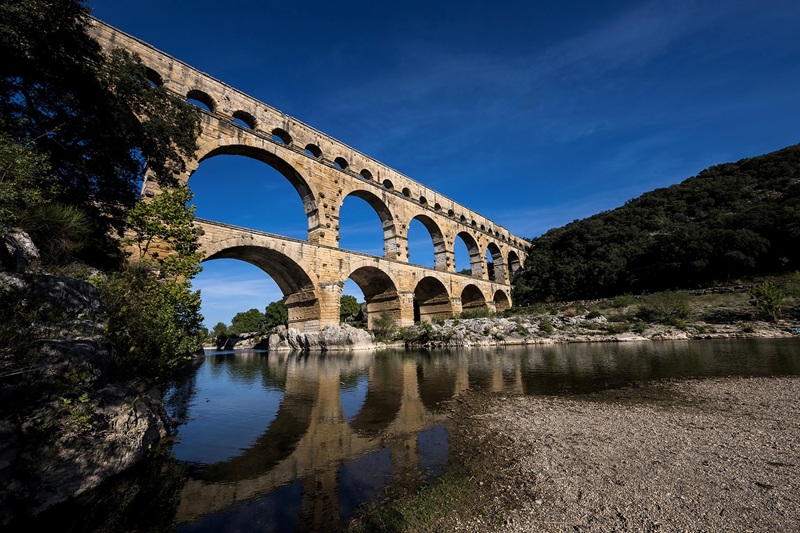
Set in the sunlit rolling countryside of southern France, the Pont du Gard is one of the best preserved and most striking Roman monuments in Europe.
Spanning the softly winding Gardon River in three tiers of pale limestone arches, it combines impressive scale with remarkable simplicity, drawing visitors for both its history and spectacular setting.
Built in the first century AD, the massive bridge formed part of a 50-kilometre aqueduct system that carried water from a natural spring near Uzès to Nîmes, then a thriving Roman city of up to 50,000 inhabitants. While most of it ran underground, this elevated section solved the problem of crossing the wide river valley.
Impressive feat of engineering
What makes it remarkable is the level of precision involved. Over its entire length, the aqueduct drops only about 17 metres, allowing water to flow steadily using gravity alone. Even a slight miscalculation would have rendered the system useless.
At its peak, the aqueduct delivered an estimated 20,000 to 40,000 cubic metres of water each day, feeding fountains, baths and homes across Nîmes. It was a vital part of daily life, and its scale reflects the ambition of Roman urban planning.
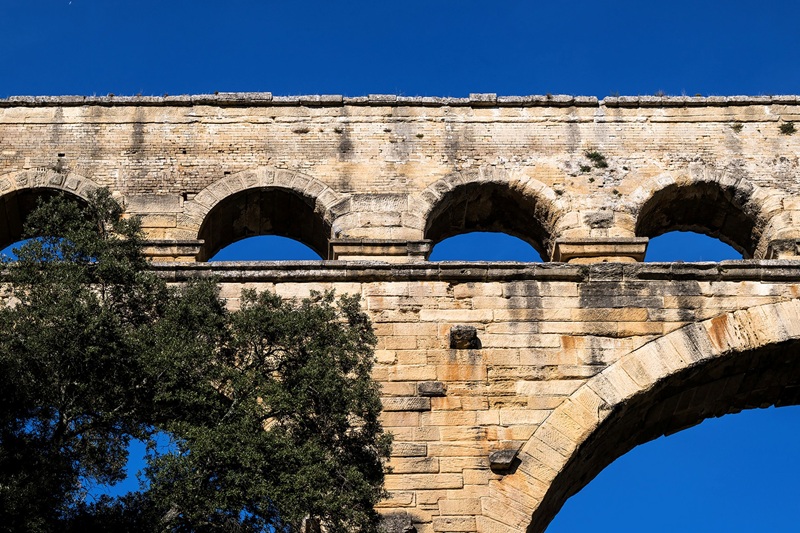
Standing beneath the bridge today, the craftsmanship is just as impressive as the concept. The structure reaches nearly 50 metres high and was built without mortar or metal clamps.
Instead, precisely cut limestone blocks, some weighing up to six tonnes, were fitted together so tightly that they have remained in place for over 2,000 years.
Many of the stones were marked and assembled in sequence, almost like an early form of prefabrication.
Construction would have required around 1,000 workers, using wooden cranes and human-powered treadwheels to lift the heavy blocks into position.
Looking closely, you might notice that the arches are not perfectly identical. The Romans adjusted their size slightly to account for weight distribution and the natural shape of the valley, a subtle detail that contributes to the bridge’s durability.
Although the aqueduct fell out of use centuries ago, the structure itself continued to serve a purpose. In the Middle Ages, it was adapted into a toll bridge, with parts of the original stone cut away to make space for carts and traffic.
This caused damage over time, and by the 17th and 18th centuries the bridge had fallen into neglect, with some stones even removed for other building projects.
Its survival is partly thanks to later intervention. In the early 19th century, during the time of Napoleon Bonaparte, a separate road bridge was built alongside it, helping to preserve the original Roman structure from further damage.
Despite its long history, much of the original design remains intact. At the very top sits the former water channel, still visible today, with traces of mineral deposits left behind by centuries of flowing water.
Magnet for tourists
The site was recognised as a UNESCO World Heritage Site in 1985, cementing its status as one of the finest examples of Roman engineering.
Today, the Pont du Gard is as much about the setting as the structure itself. The surrounding landscape, low vegetation, open skies and the gently flowing river, makes it an easy place to relax.
Walking paths on both sides of the Gardon offer different viewpoints, while the lower level of the bridge can be crossed on foot. In warmer months, the river that gave the aqueduct its name becomes a focal point, with shallow areas suitable for paddling or swimming.
A visitor centre and museum provide helpful background on how the aqueduct was built and used, with clear displays that add context without overwhelming the experience.
The site is located around 30 minutes by car from both Nîmes and Avignon, making it an easy addition to a wider itinerary in southern France. While public transport is available, driving remains the most convenient option, particularly if you plan to explore nearby towns.
Spring and early autumn are the best times to visit, offering warm weather without the peak-season crowds. Summer days are long and bright but can be busy, especially around midday.
For a quieter experience, aim to arrive early in the morning or later in the afternoon, when the light softens, and the atmosphere is more relaxed. To avoid the busiest spots, move beyond the main viewing areas and follow the riverside paths, where the pace is noticeably slower.
Allow a few hours to explore properly, and come prepared with comfortable shoes and water, particularly in warmer weather.
What sets the Pont du Gard apart is not just its age or scale, but the clarity of its purpose. Designed to solve a practical challenge, it remains a quiet reminder of the engineering prowess of the ancient world.